
Pain Management
Two Treatments
Each links to a dedicated page with indications, procedure, recovery timeline, and candidacy details.
- PS · 01
PRP Shoulder
Autologous PRP, ultrasound-guided — rotator-cuff tendinopathy, partial tears, biceps tendinitis, subacromial bursitis, AC-joint arthritis, frozen shoulder, mild-to-moderate glenohumeral OA.
Learn More - PK · 02
PRP Knee
Autologous PRP, the regenerative injection of choice for mild-to-moderate knee OA (KL 1-3) — plus patellar tendinopathy, MCL/LCL sprains, and select chondral lesions. The strongest evidence base of any MSK PRP application.
Learn More
From "can it relieve pain"
to "can it actually repair".
Chronic musculoskeletal pain has been dominated for decades by a simple paradigm: when something hurts, suppress inflammation. NSAIDs, corticosteroid injections, episodic physiotherapy — this approach is effective in many acute contexts. Applied to chronic tendinopathy and early-to-moderate osteoarthritis, however, its costs reveal themselves on a ten-year timeline: weakened tendons, accelerated cartilage loss, and a slowly rising dependence on pain medication.
MMC Pain Management starts from a different question. We ask not just "can this treatment ease the pain today" but "can this treatment influence the underlying tissue biology driving the pain". That is the entire point of PRP therapy: deliver a controlled regenerative signal exactly where the damage lives, and pair it with the loading rehabilitation that turns the signal into durable function.
The candid side of this: regenerative medicine cannot fix everything. Full-thickness retracted tears, bone-on-bone end-stage arthritis, active cancer, significant coagulopathies — these are scenarios where PRP is not the right answer. Our commitment is simple: when your imaging, exam, and prior-treatment history point to a good fit, we recommend treatment; when they point to a poor fit, we tell you clearly that surgical referral or conservative care is the right path, rather than billing you for regenerative therapy that won't match your anatomy.
This is also why every pain-management patient begins with a 30-45 minute clinical consultation. We review your X-ray, MRI, or ultrasound imaging, perform a physical exam, and complete Kellgren-Lawrence grading or VISA scoring. We retrace what you have tried, what worked, what didn't, and why you stopped. Only with that information in hand do we decide together whether PRP, another treatment — or referral — is the right next step.
A regenerative-medicine front door,
gated by evidence-based physicians.
Ultrasound-guided precision
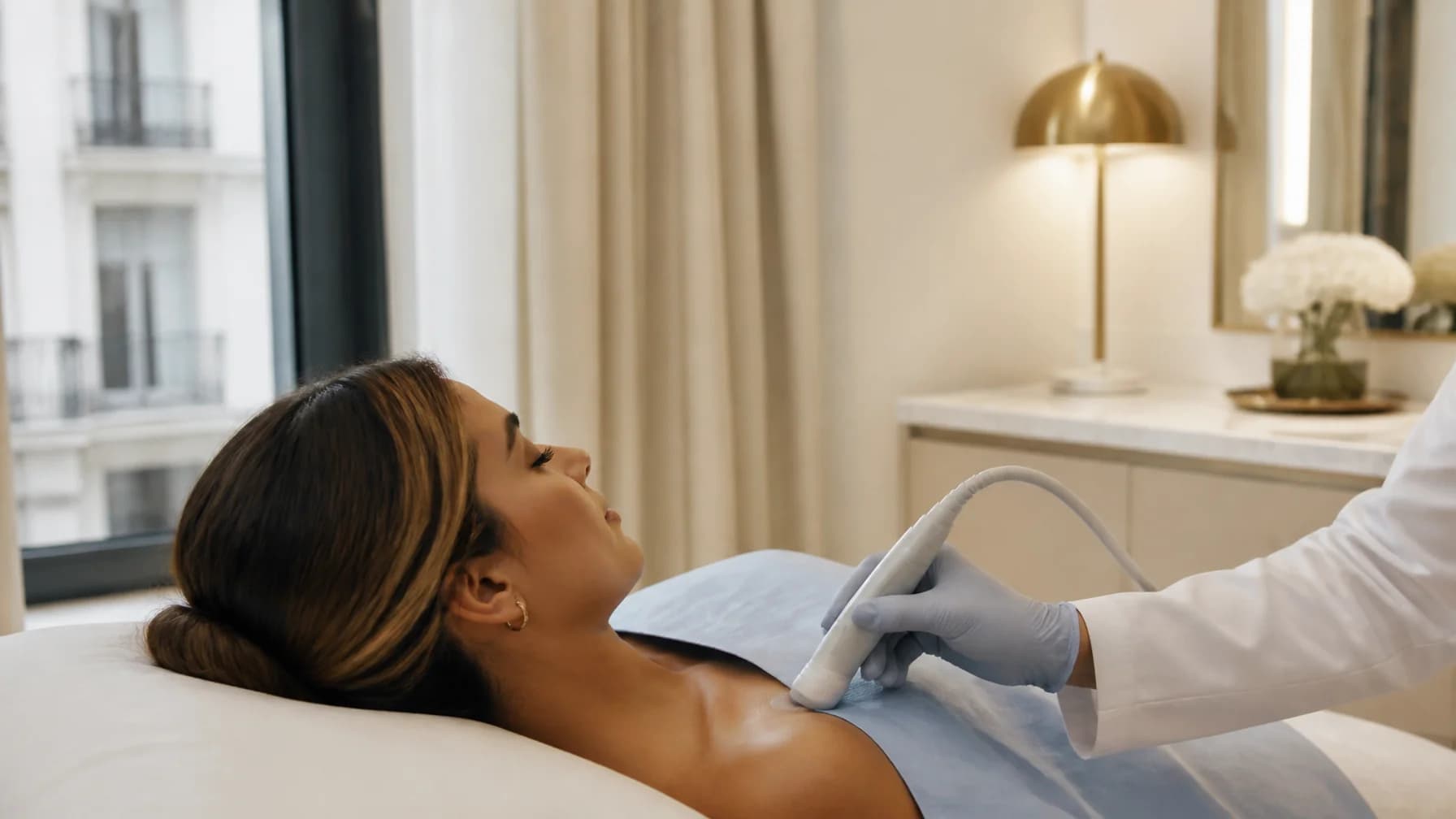
Every injection placed under live ultrasound — PRP lands on the damage, not near it. No blind sticks.
Candid candidacy assessment
Kellgren-Lawrence grading, clinical exam, and prior-treatment response together decide PRP or surgical referral.
Rehab is sequenced, not assumed
The injection is only half the work. We sequence physiotherapy and loading rehab so new tissue is loaded correctly.
Multilingual, private fast-track
45-60 minute visits at our Richmond and Vancouver clinics — multilingual reception and private-member fast-tracking.
You don't have to keep living with the pain you came in with.
Below is the list of pain conditions MMC most often treats with PRP. The list is not exhaustive — some less common but appropriate indications are assessed case-by-case, and some listed conditions may not be a good fit in your specific imaging and stage. We work through each during the consultation.
- Rotator-cuff tendinopathy & partial-thickness tears (supraspinatus, infraspinatus, subscapularis)
- Subacromial impingement & bursitis
- Long-head-of-biceps tendinopathy
- AC-joint osteoarthritis
- Frozen shoulder (adhesive capsulitis)
- Glenohumeral OA (KL 1-3)
- Knee osteoarthritis (KL 1-3)
- Patellar tendinopathy (jumper's knee)
- Grade 1-2 MCL / LCL sprains
- Pes anserine bursitis & tendinopathy
- Quadriceps tendon insertional pain
- Select chondral lesions (case-by-case)
- Tennis elbow / golfer's elbow (lateral & medial epicondylitis)
- Achilles tendinopathy & insertional heel pain
- Plantar fasciitis
- Hip OA (mild-to-moderate)
- Wrist tenosynovitis & first CMC arthritis
- Post-surgical adjunct (in coordination with your surgeon)
Four steps from first call to follow-up.
- 01
Consultation · 30-45 min
Imaging review, prior treatments, physical exam, and KL grading. A clinical assessment, not a sales pitch.
- 02
Treatment day · 45-60 min
Arm blood draw (15-60 mL), on-site centrifugation, sterile draping, local anesthetic, ultrasound-guided injection. No general anesthesia; you walk in and out.
- 03
First two weeks · controlled flare
Soreness and stiffness for 24-72 hours — this is the inflammatory phase PRP triggers by design. Ice and acetaminophen as needed; avoid NSAIDs.
- 04
Weeks 2-12 · rehab & reassessment
Progressive physiotherapy and loading rehab. Most improvement at 6-12 weeks; peak benefit at 3-6 months. Follow-up decides whether additional injections are needed.
PRP, cortisone, hyaluronic acid, arthroplasty.
Here is a side-by-side of the four most common joint-pain tools. Each has its own best-fit indications — using the wrong tool for the stage of disease blunts even the most skilled clinician. This is why imaging-based grading and candidacy assessment are non-negotiable at MMC.
| Tool | Onset | Duration | Mechanism | Best Fit | Caveat |
|---|---|---|---|---|---|
| Cortisone | Days | 4-12 weeks | Symptomatic anti-inflammatory | Acute severe inflammation | Repeated use linked to cartilage/tendon damage |
| Hyaluronic Acid | 2-4 weeks | ~6 months | Viscosupplement | Mild-to-moderate OA | Does not address underlying biology |
| PRP | 4-12 weeks | 6-18 months | Regenerative · modulates repair | KL 1-3 OA, tendinopathy, partial tears | Slower onset; requires rehab |
| Arthroplasty / Surgery | Months of recovery | 10-20+ years | Mechanical replacement / repair | KL 4 OA, complete tears | Invasive; irreversible |
Each tool, matched to the pain it fits.
- PRP KneeStrongNetwork meta-analyses of 35+ RCTs and >3,100 patients rank PRP above HA and cortisone for medium-term pain and function in mild-to-moderate KOA (KL 1-3).
- PRP Shoulder (Rotator Cuff)Moderate-Strong2025 systematic review (36 RCTs) — meaningful improvement in mid-term VAS and ASES/Constant-Murley; ~38% lower retear rate when used alongside cuff repair.
- PRP Patellar TendonModerate-StrongOutperforms shockwave and dry needling on VISA-P at >6 months.
- PRP Frozen ShoulderModerateMore durable and safer than repeated corticosteroid in recent meta-analyses.
The injection is only half the work.
The single largest variable in the success of regenerative therapy isn't the injection technique itself — it's how the tissue is loaded over the 12 weeks that follow. New collagen fibres need progressive mechanical loading to mature into a useful structure. We sequence physiotherapy alongside the injection so each phase of loading matches the maturity of the tissue.
- Days 1-3
Controlled inflammation
Soreness and stiffness expected. Ice and acetaminophen; avoid NSAIDs and vigorous activity.
- Days 4-14
Protection
Resume daily activities; avoid loaded exercise. Begin range-of-motion and light stabilization.
- Weeks 3-6
Progressive loading
Transition from concentric and isometric to eccentric loading (especially key for patellar tendinopathy).
- Weeks 6-12
Remodelling
Meaningful improvement is felt. Progressive return to running, hiking, and sport-specific training.
- 3-6 months
Peak & maintenance
Peak benefit; full return to activity. Follow-up assesses whether maintenance injections are warranted.
PRP regenerative therapy is a regenerative-medicine offering and is not covered by Canadian public health insurance (MSP). Clinical injections and prescriptions are delivered independently by partner-clinic licensed physicians, with documented informed consent. Not appropriate for patients with active cancer, who are pregnant or breastfeeding, or who have significant coagulopathies.