
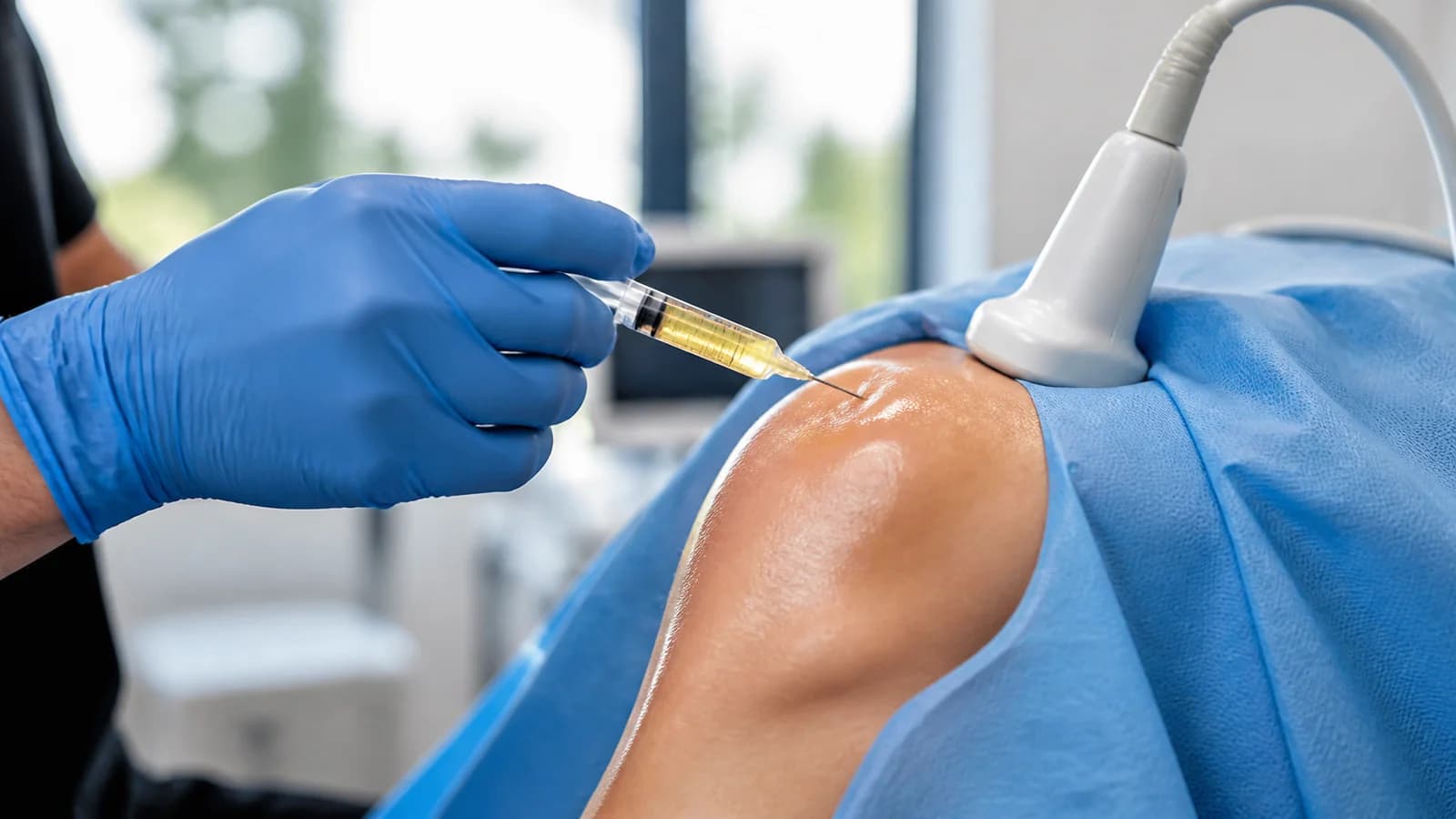
PRP Knee Injection

Regenerative, not just anti-inflammatory.
Cortisone is a potent anti-inflammatory: it calms the immune response inside the joint, brings rapid pain relief, and is symptomatically helpful for weeks to months. What it does not do is repair tissue, and the McAlindon 2017 JAMA trial — the largest randomized study of its kind — found that repeated intra-articular cortisone over two years was associated with greater cartilage volume loss than saline. Hyaluronic acid is a viscosupplement: it improves joint lubrication and provides some symptom benefit, but it is not regenerative. PRP is different in kind. The concentrated platelets we deliver release a coordinated cascade of growth factors — PDGF for fibroblast and chondrocyte recruitment, TGF-β for matrix synthesis, VEGF for angiogenesis into the synovium and subchondral bone, IGF-1 for tissue building — and a wave of anti-inflammatory cytokines that modulate the chronic, low-grade synovitis driving most osteoarthritic pain. The intent is to influence the underlying biology of the joint, not just mask symptoms. Onset is slower than cortisone (4-12 weeks rather than days), but durability is measured in many months and the regenerative direction is fundamentally different.
The strongest case in regenerative orthopedics.
Of every musculoskeletal indication for PRP, knee osteoarthritis is the most studied — and the picture from 2023-2025 is increasingly clear. Multiple network meta-analyses (Tang et al. 2023, Chen et al. 2024, Joint Bone Spine 2025) pooling more than 35 randomized controlled trials and 3,100 patients rank PRP first for WOMAC function and VAS pain at 3, 6, and 12 months — outperforming hyaluronic acid, corticosteroid, and placebo in mild-to-moderate knee OA. Leukocyte-poor preparations and platelet doses of approximately 10 billion or higher correlate with the best outcomes. The notable negative outlier was the Bennell RESTORE trial in JAMA, which showed no MRI cartilage-volume benefit at 12 months — important to acknowledge, while also noting that the trial used a single injection and that subsequent series-based protocols have shown better functional outcomes. For patellar tendinopathy, the Hong et al. systematic review in Knee Surgery & Related Research shows PRP improves VISA-P scores over both extracorporeal shockwave and dry needling, particularly past the 6-month mark. We are honest about the limits: the evidence for meniscus and isolated chondral lesions is more heterogeneous, and we will tell you when your specific imaging falls outside the well-studied indications.

Who PRP fits, and who it doesn't.
PRP is most powerful in early-to-moderate knee disease. Kellgren-Lawrence grades 1 and 2 are the sweet spot — joint space is preserved, cartilage thinning is partial, the joint still has biology to work with. KL 3 — joint space narrowed, osteophytes present — still responds, particularly with a 3-injection series, though response rates moderate. KL 4 — bone-on-bone — is where we typically have a different conversation: response rates drop sharply, and a surgical consult for partial or total knee replacement is usually the better discussion. For patellar tendinopathy, we want to see a clear ultrasound finding of tendinosis (hypoechoic thickening, neovascularization) rather than a generic anterior knee ache; that imaging changes the conversation. For MCL or LCL sprains, we prefer grade 1-2 injuries with refractory pain after the acute phase has passed; complete (grade 3) ligament tears are an orthopedic conversation, not a PRP one. We screen everyone for the standard exclusions — active local or systemic infection, active cancer, significant thrombocytopenia, anticoagulation that cannot be safely paused, pregnancy or lactation — before booking treatment.

From consultation through 6-month follow-up.
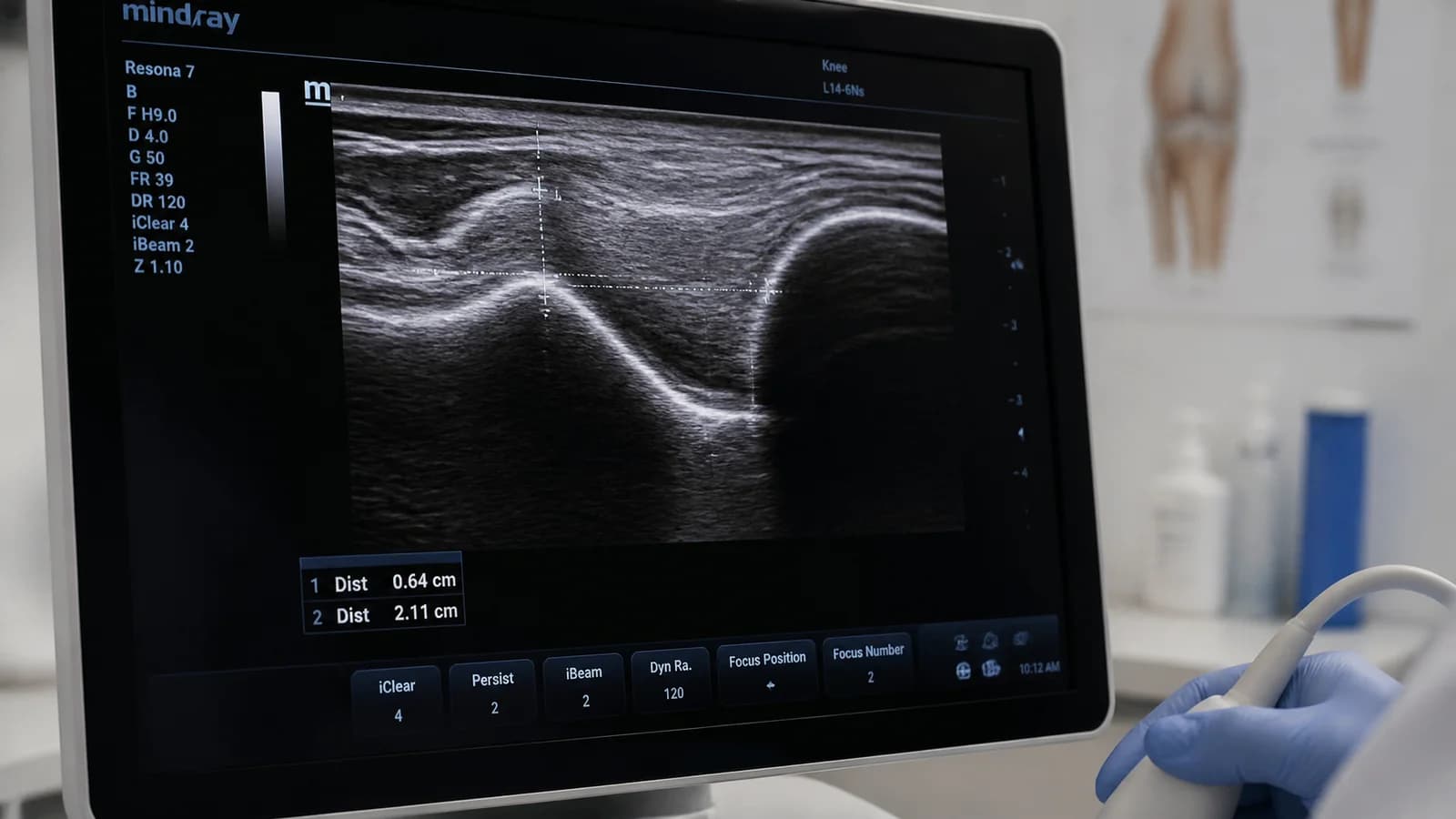
Step 1 — Consultation (30-45 minutes). We review your imaging, walk through your symptom timeline and prior treatments, perform a clinical exam (range of motion, joint-line tenderness, special tests), confirm Kellgren-Lawrence grading, and decide together whether PRP fits. Step 2 — Pre-procedure preparation. Stop NSAIDs and aspirin (if approved by your prescribing physician) seven days before the injection — they blunt the platelet signal. Hydrate well the day before. Step 3 — Injection day (45-60 minutes). A blood draw of 30-60 mL from your arm. On-site centrifugation. Sterile draping, skin cleansing, local anesthetic, then the PRP delivered intra-articularly under live ultrasound. Step 4 — First 72 hours. Expect a soreness flare — joint stiffness, warmth, mild swelling. This is the controlled inflammatory phase that triggers tissue repair. Ice and acetaminophen as needed; no NSAIDs for two weeks. Walk gently; avoid loaded exercise. Step 5 — Weeks 2-12. Progressive return to physiotherapy, gait optimization, quadriceps and hip strengthening, controlled loading. Most patients begin to notice improvement around weeks 4-6, with continued gains through week 12. Step 6 — 3-6 months. Peak benefit. We reassess function and decide whether a maintenance injection is appropriate (common for KL 3 patients) or whether the response is durable enough that further treatment is not yet needed.
- 01
Knee OA (KL 1-3)
Mild-to-moderate osteoarthritis — the most evidence-based indication. Typical series: 1-3 injections, 2-4 weeks apart.
- 02
Patellar Tendinopathy
Chronic "jumper's knee" refractory to eccentric loading — paired with structured rehab over 12-16 weeks.
- 03
MCL / LCL Sprains
Grade 1-2 medial or lateral collateral ligament injuries with refractory pain — peri-ligamentous placement under ultrasound.
- 04
Pes Anserine & Quadriceps Tendon
Less common but well-treated targets — pes anserine bursitis/tendinopathy and quadriceps tendon insertional pain.
- 05
Chondral Lesions
Select focal cartilage defects — sometimes combined with marrow stimulation; evidence is more limited and we frame this honestly.
- 06
Post-Arthroscopy Recovery
Used as an adjunct after meniscectomy or chondroplasty for select patients; evidence is mixed and we discuss expectations carefully.
- 07
Durable Relief
Most KOA responders experience 6-18 months of benefit from a single 1-3 injection treatment course. Annual maintenance is common.
- 08
Bridge to — or Alternative to — Replacement
For appropriate candidates, can delay or in some cases substitute for knee arthroplasty. We assess this honestly with your imaging.
- 09
Autologous & Drug-Free
Your own blood, processed in front of you. No donor material, no synthetic pharmaceutical, no allergic-reaction risk.
- 10
Itemized Receipts
Not covered by MSP. Physician-itemized receipts provided for extended-health benefits and the CRA Medical Expense Tax Credit.
Frequently Asked
How does PRP compare with cortisone?
Cortisone works faster (days), but the relief is symptomatic, it wears off in 4-12 weeks, and with repeated use it has been associated with accelerated cartilage loss (McAlindon, JAMA 2017). PRP is slower (4-12 weeks to take effect), but the relief lasts longer (typically 6-18 months in responders) and the mechanism is regenerative rather than purely anti-inflammatory. For sustained relief in mild-to-moderate knee OA, current network meta-analyses favour PRP.
How does PRP compare with hyaluronic acid (gel injections)?
Hyaluronic acid is a viscosupplement — it lubricates the joint and provides modest symptom benefit, typically over 6 months. Network meta-analyses from 2023-2025 consistently rank PRP above HA for both pain and function in mild-to-moderate knee OA at the medium-term mark. PRP also addresses underlying biology rather than only viscosity.
Am I too far along for PRP?
PRP performs best in Kellgren-Lawrence grades 1-3. In bone-on-bone (KL 4) disease, response rates drop substantially and a surgical consult is usually the better discussion. We review your weight-bearing X-rays and MRI during consultation and will tell you honestly when arthroplasty is the right path.
Will it hurt?
A small blood draw and a brief injection, both performed with local anesthetic. The 24-72 hours after the injection typically involve a soreness or stiffness flare — this is normal and a sign that the inflammatory phase of healing has been triggered, not a complication. Ice and acetaminophen as needed; no NSAIDs for two weeks.
How many injections will I need?
For knee osteoarthritis, a series of 1-3 injections spaced 2-4 weeks apart is typical. KL 1-2 patients often do well with 1-2 injections; KL 3 patients usually benefit from the full 3-injection series. Patellar tendinopathy is usually 2-3 injections paired with eccentric loading rehab. Annual maintenance is common for KOA patients who respond well.
When can I return to running, hiking, or sport?
Days 1-7: light walking only, no loaded exercise. Weeks 2-4: gradual return to bicycling, swimming, and gym work without high impact. Weeks 4-12: progressive return to running, hiking, and sport as comfort and physiotherapy allow. By month 3-6 most responders are back to full activity. We sequence this in detail at the consultation.
Is it covered by MSP?
No. PRP is a private-pay regenerative service in British Columbia. Pricing in the Lower Mainland is typically $600-$1,200 CAD per ultrasound-guided injection. We provide itemized physician receipts for extended-health benefit submission and for the CRA Medical Expense Tax Credit.
Who should not get PRP?
Active local or systemic infection, active cancer not in stable remission, significant thrombocytopenia or coagulopathy, therapeutic anticoagulation that cannot be safely paused, pregnancy or lactation, and end-stage (KL 4) OA where arthroplasty is indicated. Recent intra-articular cortisone in the same knee requires a 6-8 week wait.