
PRP Shoulder Injection
Your body's own healing concentrate.
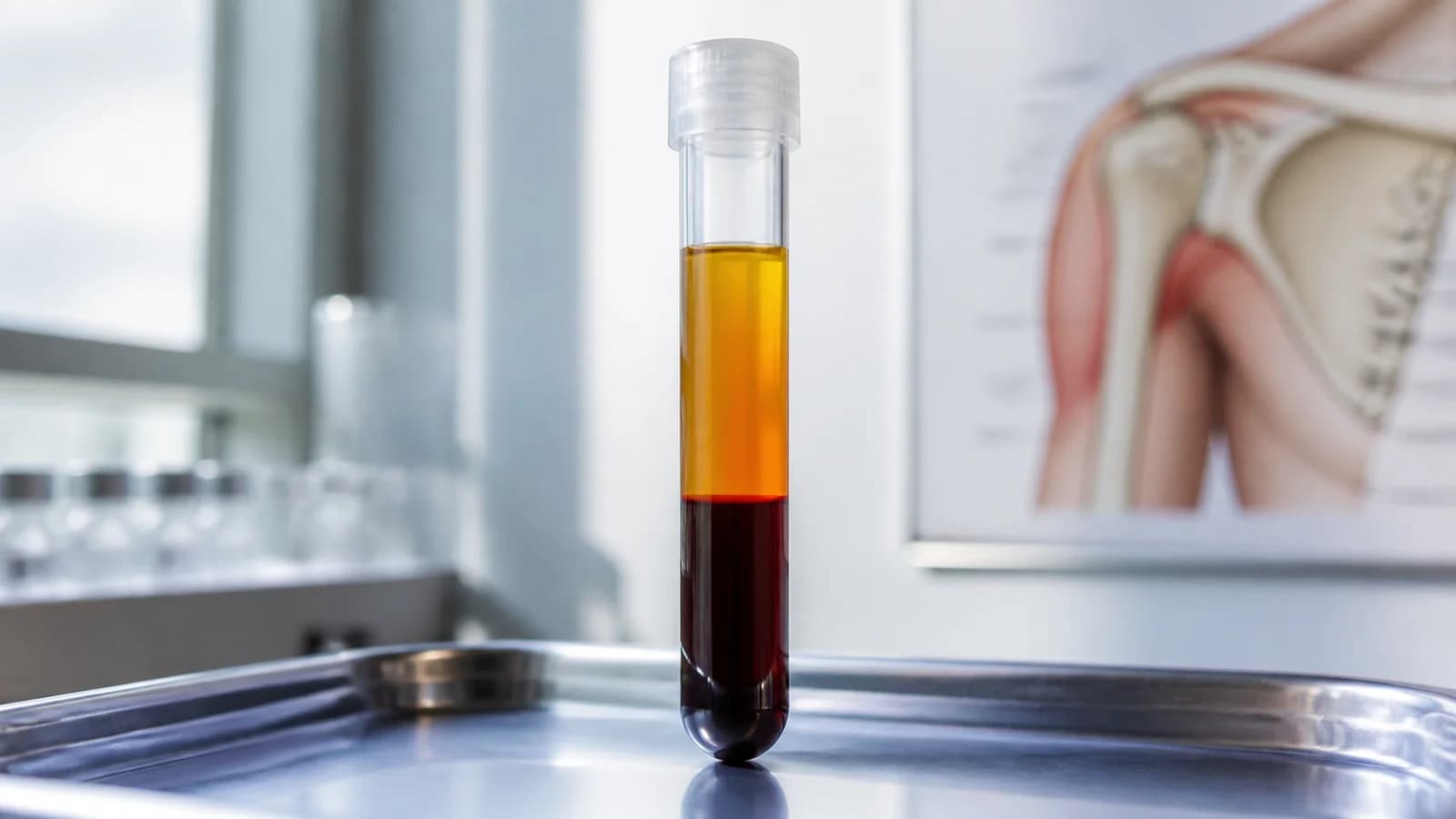
PRP — Platelet-Rich Plasma — is a concentrate of platelets prepared from a small sample of your own blood. After we draw 15-30 mL from your arm, the sample is spun in a specialized centrifuge that separates the layers: the heavy red cells settle to the bottom, the platelet-rich plasma layer rises to the top, typically at four-to-seven times your baseline platelet count. That platelet fraction is what we re-inject into the injured tendon, bursa, or joint capsule. Because it is autologous — derived from your own body — there is no donor risk, no allergic-reaction risk, and no synthetic drug entering your system. Once placed, the platelets degranulate and release a coordinated cascade of growth factors and cytokines — PDGF for cell recruitment, TGF-β for collagen synthesis, VEGF for angiogenesis, IGF-1 for tissue building, FGF for matrix remodelling. These are the same signals your body uses every time it heals a paper cut; PRP simply concentrates them at the exact site that has been failing to heal on its own.

What PRP can — and cannot — do for the shoulder.
The most common indication is rotator-cuff tendinopathy and partial-thickness tears, where the supraspinatus or infraspinatus tendon fibres have become disorganized and pain-generating but have not yet retracted. PRP performs well here, and the 2025 RCT literature is increasingly clear. Long-head-of-biceps tendinopathy and subacromial bursitis often respond rapidly because both are accessible, well-vascularized targets under ultrasound. AC-joint arthritis — a small but highly innervated joint at the top of the shoulder — is a frequent overlooked source of pain that responds well to a single small-volume PRP injection. Frozen shoulder (adhesive capsulitis) is where recent meta-analyses are tipping toward PRP over repeated corticosteroid, particularly for second-injection durability. Glenohumeral osteoarthritis in the Kellgren-Lawrence 1-3 range can be meaningfully eased with a 3-injection series. Where PRP is the wrong tool: large full-thickness retracted cuff tears with fatty atrophy, end-stage glenohumeral OA where arthroplasty is the right answer, massive irreparable tears. We will tell you honestly when one of those is the case and refer you onward.
We do not inject what we cannot see.
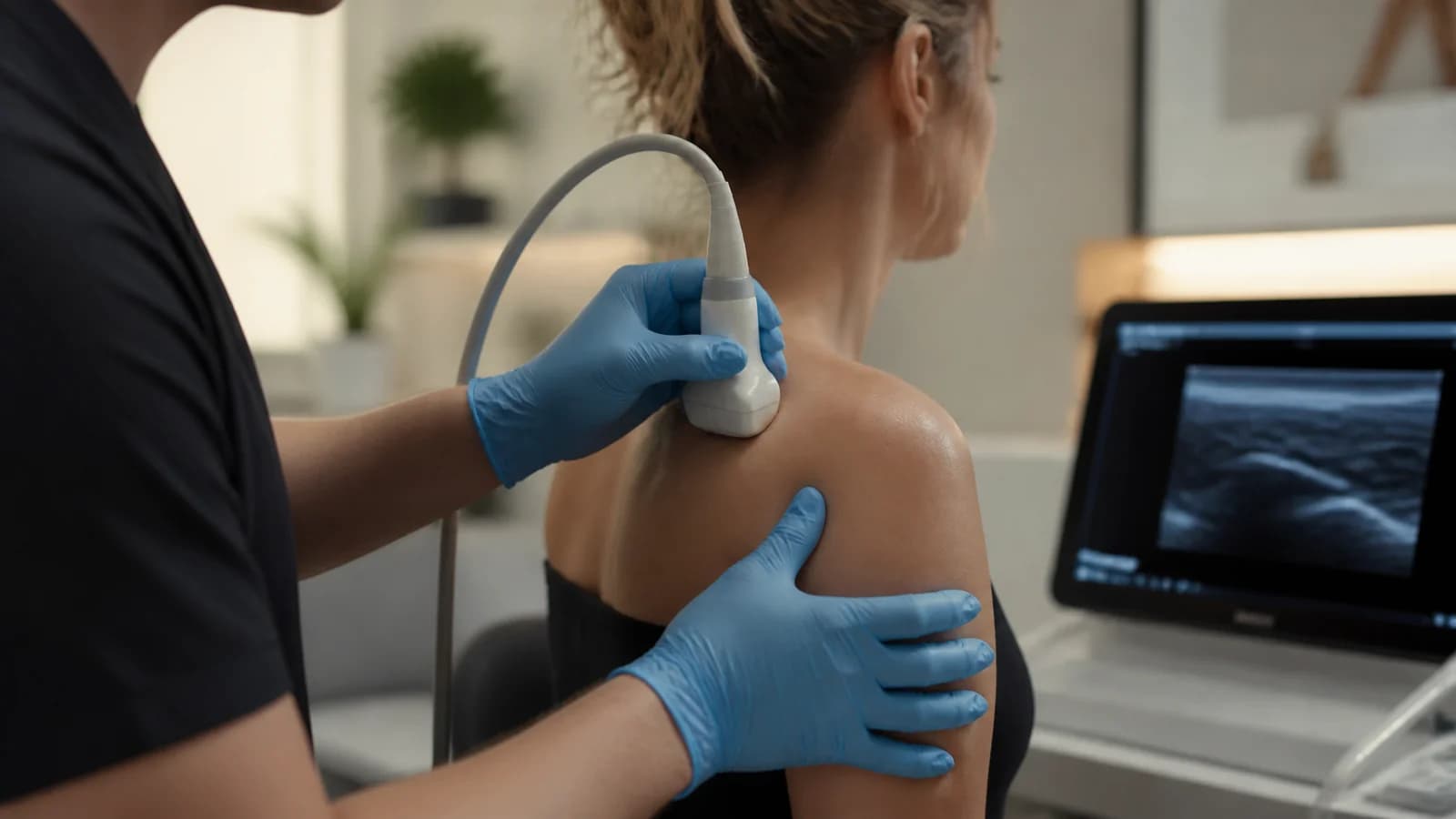
Every shoulder injection at MMC is performed under live musculoskeletal ultrasound. Before the needle moves, we map your anatomy on screen — the supraspinatus footprint, the long-head-of-biceps groove, the AC-joint capsule, the subacromial-subdeltoid bursa. As the needle advances, we watch its tip in real time and watch the PRP spread into the target structure. This matters because the shoulder is a small, complex, layered joint: a millimetre's difference puts the platelets in the bursa instead of the tendon, or in soft tissue instead of the joint. Studies comparing blind and ultrasound-guided shoulder injections find substantially higher accuracy with guidance, particularly for the subacromial bursa and AC joint. For a regenerative therapy that depends on platelets reaching the damage to do their work, that precision is not a luxury — it is the difference between a therapy that works and one that doesn't.

From consultation to follow-up — the full arc.
Step 1 — Consultation (30-45 min). We review your symptoms, prior imaging (X-ray and any MRI), prior treatments and what they did or didn't do, your medications, and your goals. We grade and stage your shoulder problem and decide together whether PRP is the right tool. Step 2 — Treatment day (45-60 min). A standard arm-vein blood draw of 15-30 mL, centrifuged on-site, drawn into a syringe, and injected under ultrasound after a small local anesthetic. You walk in and walk out; no general anesthesia, no IV sedation. Step 3 — First 48-72 hours. Expect a soreness flare. This is the inflammatory phase of healing that PRP is designed to trigger; it is therapeutic, not a complication. Ice, acetaminophen as needed (no NSAIDs), relative rest. Step 4 — Weeks 2-12. Progressive physiotherapy and rotator-cuff loading rehab. Most patients begin to notice meaningful improvement between weeks 6 and 12. Step 5 — 3-6 months. Peak benefit. We re-assess and decide whether a second or third injection is warranted, whether continued rehab alone will suffice, or whether the response indicates a different problem requires attention.
- 01
Rotator Cuff Tendinopathy
Tendinosis and partial-thickness tears of the supraspinatus, infraspinatus, subscapularis — non-surgical option for appropriate candidates.
- 02
Subacromial Impingement
Refractory impingement / bursitis where physiotherapy and conservative care have stalled.
- 03
Frozen Shoulder
Adhesive capsulitis — meta-analyses suggest PRP is more durable and safer than repeated corticosteroid for capsular inflammation.
- 04
Biceps Tendinopathy
Long-head-of-biceps tendinosis at the bicipital groove — a precise ultrasound-guided peri-tendinous target.
- 05
AC-Joint Arthritis
Small but highly innervated joint, often overlooked as a pain source — single small-volume injection.
- 06
Glenohumeral OA (KL 1-3)
Mild-to-moderate shoulder osteoarthritis — typically a 3-injection series at 4-6 week intervals.
- 07
Surgical Adjunct
Used alongside rotator-cuff repair, recent RCT data shows approximately 38% lower retear rates over 12-24 months.
- 08
Series Protocol
Typically 1-3 injections, 4-6 weeks apart. Meaningful improvement most often at 6-12 weeks; peak benefit at 3-6 months.
- 09
Autologous & Drug-Free
Your own blood, processed in front of you. No donor material, no synthetic pharmaceutical, no allergic-reaction risk.
- 10
Itemized Receipts
Not covered by MSP. Many extended health plans reimburse partially; CRA Medical Expense Tax Credit applies. Physician-itemized receipts provided.
Frequently Asked
Does PRP regrow a torn rotator cuff?
No, and any clinic that says otherwise is overstating what the evidence shows. PRP modulates inflammation and stimulates the body's own repair pathways. It can shrink partial-thickness tears, calm tendinopathic fibres, and meaningfully reduce pain, but it will not close a large full-thickness retracted tear or restore a massively atrophied tendon. For those cases, surgical referral remains the right answer, and we will tell you so during the consultation rather than billing you for treatment that won't fit your anatomy.
How soon will I feel better?
Most patients notice meaningful improvement between weeks 6 and 12, with peak benefit at 3-6 months. Some respond earlier; some take longer. The first 2-5 days typically involve soreness — this is normal and a sign that the inflammatory phase of healing has been triggered. NSAIDs are avoided for 5-7 days before and approximately 2 weeks after the injection because they blunt the PRP signal. Acetaminophen and ice are fine if needed.
Is the injection painful?
The blood draw is the same as any routine lab visit. The injection itself is performed with topical and local anesthetic and under ultrasound guidance — most patients describe a pressure sensation rather than sharp pain. The most uncomfortable phase is usually 24-48 hours afterward, when the controlled inflammatory response peaks. By day 5 the soreness has usually settled.
How is PRP different from a cortisone shot?
Cortisone is a potent anti-inflammatory: it works fast (days), but it is symptomatic, it wears off in weeks to months, and with repeated use it has been associated with tendon weakening and cartilage damage. PRP is regenerative: slower onset (weeks), but it aims to influence the underlying tissue biology rather than mask symptoms, and durability is measured in months not weeks. For sustained relief in rotator-cuff disease, frozen shoulder, and mild-to-moderate shoulder OA, current evidence increasingly favours PRP.
How many injections will I need?
For most tendinopathy and impingement, 1-2 ultrasound-guided injections are typical. For frozen shoulder, AC-joint arthritis, and mild-to-moderate glenohumeral OA, a 3-injection series at 4-6 week intervals is the standard protocol. We reassess after each injection — if you have already met your goals, we stop.
Who is not a candidate?
Active local or systemic infection (including untreated dental infection), active cancer not in stable remission, significant thrombocytopenia or coagulopathy or therapeutic anticoagulation that cannot be safely paused, pregnancy or lactation, large full-thickness retracted rotator-cuff tears with fatty atrophy, and end-stage glenohumeral OA where arthroplasty is the appropriate referral. We screen all of this in advance.
Can I drive home after the injection?
Yes. There is no general anesthesia and no IV sedation, only a small amount of local anesthetic. Many patients return to a desk job the same afternoon. We do recommend you avoid heavy lifting, overhead work, or sport for 5-7 days.
How much does it cost in BC?
Typical Lower Mainland pricing is $600-$1,200 CAD per ultrasound-guided injection, depending on the joint and complexity. Not covered by MSP. Itemized physician receipts are provided for extended-health benefit submission and for the CRA Medical Expense Tax Credit.